
It’s Dyslexia Awareness Week (6–12 October), and October is a month when lots of parents start to wonder.
The first school reports are coming home. Parents’ evening is on the calendar. And the homework battles that started in September haven’t gone away.
Maybe your child is bright, chatty and curious, but the words just don’t seem to land on the page. Maybe reading at bedtime ends in tears. Maybe you’ve been told, “They’ll catch up,” or “They just need to try harder.”
If any of that sounds familiar, this post is for you. You’re not imagining it, and you’re definitely not alone. Dyslexia is common. The British Dyslexia Association estimates that around 1 in 10 people are dyslexic, which could mean two or three children in every class.
So this week, let’s do something useful. Grab a cup of tea, read through the checklist below, and count how many sound like your child.
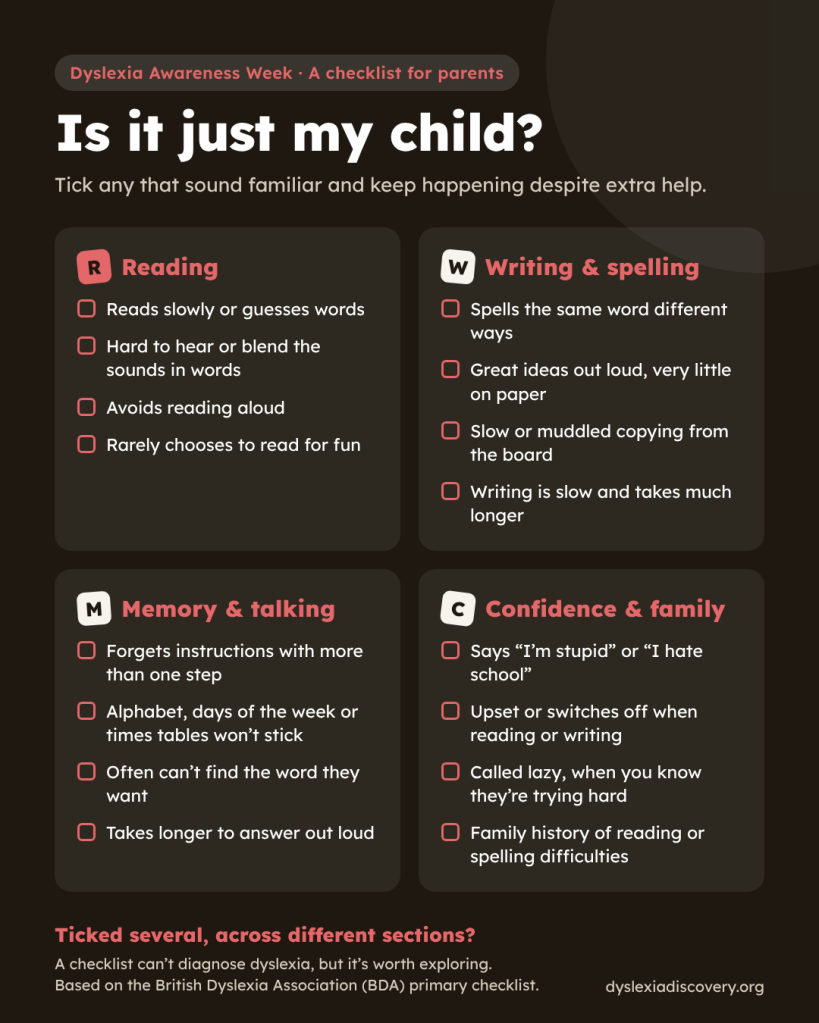
The “sounds familiar?” checklist
Count any that sound like your child. Most children will do some of these sometimes. What matters is when lots of them happen, and they keep happening despite extra help.
Reading
- Reads slowly, or guesses words from the first letter or the pictures
- Finds it hard to hear the separate sounds in words, or to blend sounds together (c‑a‑t → cat)
- Avoids reading aloud, or gets anxious when asked to
- Rarely chooses to read for fun
Writing and spelling
- Spells the same word in different ways, even after practising it
- Has great ideas when talking, but writes very little
- Copying from the board is slow or full of mistakes
- Writing is slow and tiring, and takes much longer than for classmates
Memory and talking
- Finds it hard to remember instructions with more than one step
- Struggles to learn sequences: the alphabet, days of the week, months, times tables
- Often can’t find the word they want, or mixes up sounds in longer words
- Takes a little longer than others to answer a question out loud
Confidence and family
- Says things like “I’m stupid” or “I hate school”
- Gets upset, switches off or messes about when reading or writing is involved
- Has been called lazy or not trying, when you know they’re working hard
- Someone in the family has had similar difficulties with reading or spelling
Strengths to look out for too
Dyslexia isn’t only about difficulties. Many children with dyslexia also:
- understand a story well when it’s read to them
- have lots of creative ideas
- are good at solving problems, building or practical tasks
- see the big picture quickly
- are curious and ask lots of questions
- know a lot about the things that interest them
How many did you count? A checklist can’t tell you whether your child is dyslexic. Only a full assessment can do that. But if you counted several, especially across different sections, it’s worth exploring further.
Where this checklist comes from: I’ve written it in my own words, based on the primary school checklist published by the British Dyslexia Association (BDA), the UK’s national charity for people with dyslexia.
Myth or fact?
Dyslexia Awareness Week is a great time to clear up a few things parents often hear.
“Dyslexia means you see letters backwards.” Myth. Lots of young children reverse letters, and it’s a normal stage. Dyslexia is mainly about how the brain processes the sounds in language, how quickly it retrieves words, and how much it can hold in memory at once.
“If they can read, they can’t be dyslexic.” Myth. Many dyslexic children learn to read accurately but read slowly and find it exhausting. Others read well but really struggle with spelling and getting their ideas onto paper.
“Dyslexia is linked to intelligence.” Myth. Dyslexia happens across the whole range of ability. Many dyslexic children are bright, creative and articulate, which is exactly why their difficulties can be missed.
“They’ll grow out of it.” Myth. Dyslexia is lifelong. With the right understanding and support, though, children can develop strategies that help them thrive.
“It’s too late to get assessed now they’re older.” Myth. It’s never too late. I regularly assess teenagers and young adults who have struggled quietly for years. Understanding why can be a huge relief at any age.
“Dyslexia runs in families.” Fact. If a parent or sibling has dyslexia, a child is more likely to have it too.
What can you do this week?
You don’t have to have all the answers today. Here are three small steps:
- Write down what you notice. Jot down specific moments, such as a spelling test, a homework struggle or something your child said. Real examples are much more useful than a general feeling.
- Talk to school. Ask your child’s teacher or the SENCO what they see in class. Ask what support is already in place and how it’s going.
- Talk to your child. Keep it light. Ask what feels hard and what feels easy. Many children are relieved just to be asked.
What a full assessment actually involves
If difficulties carry on despite extra help, a full diagnostic assessment can give you clear answers. Here’s what it looks like with me:
- Well before the day, I gather background information from you and your child’s school, so I understand the whole picture.
- On the day, your child works with me one-to-one in a calm, quiet space in Leigh-on-Sea. It takes 2–4 hours, with plenty of breaks. The activities feel more like puzzles and word games than a test, and most children are surprised by how much they enjoy it.
- Afterwards, you receive a full written report. It explains whether your child has dyslexia, what their strengths are, where they find things harder, and practical recommendations for home and school.
- If you’d like to talk it through, you can request a 20-minute follow-up call to ask any questions.
I assess children and young people aged 8 to 25.
“I wish we’d done this sooner.”
A parent, after their child’s dyslexia assessment
Over to you
I’d love to hear from you this Dyslexia Awareness Week. Leave a comment below:
- How many did you count on the checklist?
- What’s one thing you wish people understood about your child?
- Are you dyslexic yourself? What helped you most at school, or what do you wish had helped?
Your story might be exactly what another parent needs to read today.
Ready to find out more?
If this post has raised questions about your child, I’m happy to have a no-pressure chat about whether an assessment is right for them.
Email rosie@dyslexiadiscovery.org or send an enquiry here.
And if you know a parent who’s been worrying, please share this post with them. It might be the nudge they need.
Rosie Stokes, Specialist Dyslexia Teacher and Assessor (PG Cert, APC), Dyslexia Discovery, Leigh-on-Sea, Essex


Leave a Reply